
Are you buying a house with energy label E, F or G from Friday 1 January 2027, with a mortgage backed by the National Mortgage Guarantee (NHG)? Then your loan will include at least €20,000 as standard to make the home more energy efficient. It is not compulsory, you can opt out. If you buy an apartment, the rule does not apply.
What changes with NHG in 2027?
NHG is a safety net in case you can no longer pay your mortgage later on. The rules for 2027 (in Dutch) contain a new starting point. If you buy a house with label E, F or G with NHG, your loan includes at least €20,000 for energy-saving measures. You have two years to decide when and how to make the improvements. Whatever you have not used by then is automatically paid off your mortgage. You do not have to reach a particular label.
You can already borrow extra for energy improvements now, but you have to ask for it yourself, and few people do. NHG is now turning that around. Director Roald van der Linde: “With a home that has a poor label, energy improvements should simply be on the table straight away.”
Do you really have to borrow that €20,000?
No. If you do not want it, you sign a statement that you will not use the budget. NHG is still working out that form. Useful if you pay for the improvements with your own money or through the Warmtefonds (the Dutch national fund for energy-saving loans).
The amount also has to fit within what you are allowed to borrow based on your income and the value of the house. If €20,000 does not fit, it will be less. In a worked example from NHG itself, the home is worth €300,000, and the maximum comes out at €18,000. If you borrow more than the NHG limit, you do not have NHG and the rule does not apply either.
It is still borrowed money. If you use the budget, your mortgage goes up and so do your monthly payments.
Does the rule also apply to an apartment?
No. NHG excludes homes owned as an apartment right (appartementsrecht), the legal form in which you own an apartment in the Netherlands. According to the City of Amsterdam (Onderzoek en Statistiek, factsheet Wonen in Amsterdam 2025), only 17 percent of homes in Amsterdam are single-family houses (eengezinswoningen), compared with 47 percent in the region as a whole. Even a ground-floor apartment with its own garden is almost always an apartment right in Amsterdam, so it falls outside the rule.
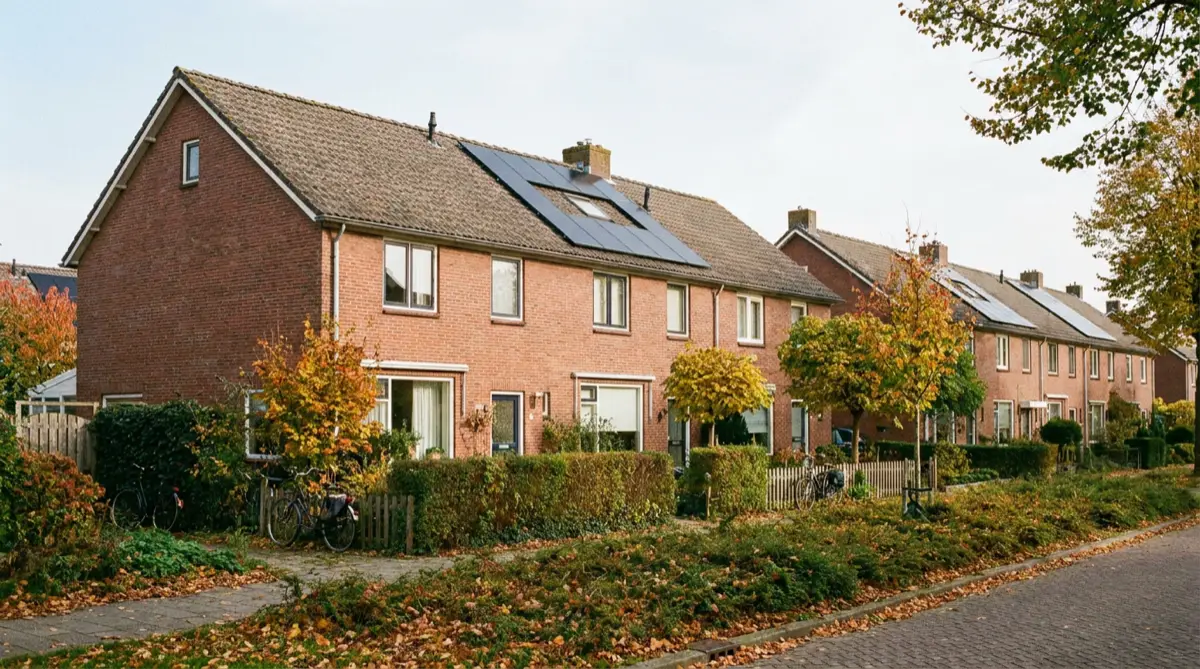
In the city, you mainly find single-family houses in Amsterdam-Noord, in garden villages (tuindorpen) such as Tuindorp Oostzaan and the Vogelbuurt. You also find them in Nieuw-West, for example in Osdorp and Geuzenveld, and here and there in West.
Buying a house with label E, F or G? This is our advice
If you can, keep the €20,000 in your mortgage. It lets you improve the label considerably. Start with the quick wins:
- insulating the crawl space;
- solar panels on the roof.
About solar panels: the net metering scheme (salderingsregeling) ends on Friday 1 January 2027, according to the Dutch government (Rijksoverheid). After that, electricity you feed back into the grid can no longer be offset against what you use. The panels do still count towards the energy label, and they pay off most when you use the electricity yourself.
New window frames, new glazing, wall insulation and roof insulation are bigger jobs. You can use the budget for those too, and with two years to do it, you can plan them calmly.
Selling a house with label E, F or G?
If there are easy measures that raise your label, do them before you sell. Then have a new energy label issued, otherwise a buyer will not see the improvement. If the work is major, it is usually best to leave it to the buyer. They often want to change things anyway, and from 2027, with NHG, they will have money for energy improvements as standard.
Buying an apartment with a poor label?
Then you have less freedom. Windows, facade and roof fall under the owners’ association (Vereniging van Eigenaren, VvE), so you cannot simply replace them yourself. With a poor label, we therefore always ask the seller for the monthly energy consumption. That often tells you more about what you will pay than the label itself.
In an apartment, there are quick wins too:
- smart radiator valves;
- radiator foil behind the radiators;
- possibly a fan behind the radiator.
If you do want to include something in your mortgage, ask your mortgage adviser what is possible in your situation.
Unsure about a house with a poor label? As your buying agent, we will look at it with you. Selling yourself? Take a look at our selling agent page. Feel free to call or email.
Frequently asked questions
When do the new NHG rules come into force?
On Friday 1 January 2027. NHG will publish the final rules for 2027 at the end of October or the beginning of November 2026. Until then, details may still change.
What is the NHG limit in 2027?
€500,000, or €530,000 if you include energy improvements in your mortgage. In 2026, it is €470,000 and €498,200. For NHG, you pay a one-off premium of 0.4 percent of your mortgage amount, and that stays the same in 2027. That premium is part of the buying costs (kosten koper).
What happens to the money if I do not use it?
You have two years. If you have not started by then, or you have spent less, whatever is left is automatically paid off your mortgage.
Can I already borrow extra for energy improvements now?
Yes. In 2026, with label E, F or G you can borrow up to €20,000 extra for energy-saving measures, with label C or D €15,000 and with label A or B €10,000. You do have to ask your mortgage adviser for it yourself.