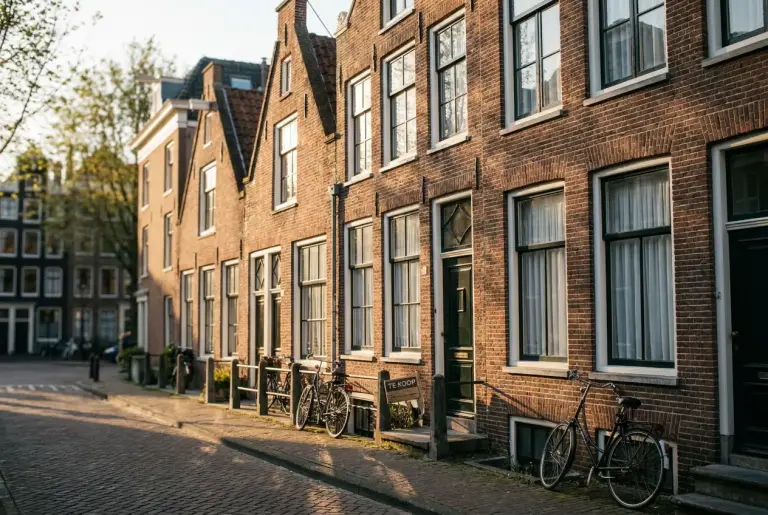
From 1 January 2027 the NHG limit rises to €500,000, the starter’s exemption applies up to a property value of €615,000 and most buyers can borrow a little more. New for anyone who wants to buy a house in 2027: a high foundation risk now counts for a mortgage with NHG. In Amsterdam, with so many houses on wooden piles, that is the change to watch.
What is the NHG limit in 2027?
The limit for the National Mortgage Guarantee (NHG) goes from €470,000 to €500,000. If you also finance energy-saving measures, the limit is €530,000. With NHG you usually get a lower interest rate. The fee stays at 0.4% of the amount you borrow (NHG, October 2026).
Can you borrow more in 2027?
Yes, a little. The new lending standards were published in the Government Gazette (Staatscourant) in early November 2026. According to Nibud, the Dutch budget information institute, this adds at most around €10,000 of borrowing capacity without a pay rise. If your salary goes up by the expected 3.7%, it means €10,000 to €35,000 extra. A higher mortgage rate can partly cancel out that gain.
If you buy on your own, a fixed extra amount of €18,000 counts in 2027.
How high is the limit for the starter’s exemption in 2027?
Are you between 18 and 35, have you not used the exemption before and will you live in the home yourself? Then you pay no transfer tax (overdrachtsbelasting) if the property costs no more than €615,000. In 2026 that was €555,000 (government letter to parliament, October 2026). On an apartment of €600,000, that saves you €12,000.
What counts is the date on which you sign the deed of transfer (akte van levering) at the civil-law notary. If the value is above the limit, you pay 2% on the full amount. What else you can expect to pay is in our blog on the costs of buying a house in Amsterdam.
What do you pay if you will not live in the home yourself?
If you buy a home to rent out, as a second home or for your child, you currently pay 8% transfer tax. The government wants to lower this to 7% in 2027. This is part of the 2027 Tax Plan (Belastingplan 2027): the House of Representatives has voted in favour, the Senate (Eerste Kamer) still has to vote. If you live in the home yourself, you keep paying 2%.
Why does foundation risk count from 2027?
Since April 2026 the valuer gives every home a foundation risk class, from A (low) to E (high). From 2027 that class counts for a mortgage with NHG. If a home falls into class D or E, an exploratory foundation survey (verkennend funderingsonderzoek) is required. If that survey shows a high risk, the expected repair costs are deducted from the maximum you are allowed to borrow (NHG, conditions and standards 2027).
Many older Amsterdam houses stand on wooden piles, so you notice this here sooner than elsewhere. How it works exactly is in our blog on borrowing for a house on wooden piles.
What is new for a house with energy label E, F or G?
If you buy a house with label E, F or G with NHG, from 2027 your mortgage will by default include €20,000 to make the home more energy efficient. This does not apply to an apartment, so it does not apply to a large share of Amsterdam homes. You can turn the amount down, and you have two years to start using it. More on this in our blog on NHG and the energy label.
What changes in the mortgage interest deduction?
In 2027 you can deduct the interest on your mortgage (hypotheekrenteaftrek) at a maximum rate of 38.16%. This is also part of the 2027 Tax Plan and is still waiting for the Senate. The notional rental value (eigenwoningforfait), the amount you add to your income for owning your home, stays at 0.35% of the WOZ value up to €1,360,000 (Tax Key Figures 2027, Fiscale sleuteltabel).
What changes for houses with solar panels?
On 1 January 2027 the net metering scheme (salderingsregeling) ends. You can then no longer offset the electricity your panels feed back into the grid against the electricity you use yourself. Solar panels therefore earn you less. Electricity you use yourself straight away still saves you money (Dutch government).
What changes in Amsterdam itself?
For perpetual ground lease (erfpacht) under the AB 2016 conditions, the annual ground rent (canon) rises by 2.9% in 2027, in line with inflation (Amsterdam Municipal Gazette, August 2026). More about ground lease is in our blog Ground lease in Amsterdam.
The buy-to-let protection (opkoopbescherming) does not change on 1 January 2027. The national government is working on a new scheme per neighbourhood, but that will only take effect later (Dutch government, October 2026).
Frequently asked questions
For the starter’s exemption, does the purchase date or the transfer date count?
The transfer date. What counts is the day you sign the deed of transfer at the civil-law notary. If you buy at the end of 2026 and sign at the notary in 2027, the €615,000 limit applies.
Does the starter’s exemption also apply if the house costs more than €615,000?
No. If the value is above the limit, you pay 2% transfer tax on the full amount, even if you are under 35.
What is the difference between the NHG limit and the limit for the starter’s exemption?
The NHG limit is about your mortgage: you can borrow up to €500,000 with the National Mortgage Guarantee. The starter’s exemption is about transfer tax: up to a property value of €615,000 you do not pay it as a starter. The two limits are separate from each other.
Does the €20,000 for energy-saving measures also apply to an apartment?
No. The rule only applies to houses without an apartment right (appartementsrecht), with energy label E, F or G and a mortgage with NHG.
Would you like to know what these rules mean for a home you want to buy or sell? Feel free to call or email us. You can read more about how we work on our pages for a buying agent in Amsterdam and a selling agent in Amsterdam.